Wednesday, July 9, 2014

Life in Zobue: Making Bricks

For the past couple of weeks a main project in Zobue has been brick making.  Apparently it’s brick making season.  The process is quite extensive.  Luckily, all the materials are readily available.  Here’s a quick how to for brick making.  Most of the information in this tutorial was gathered by simple observation, so I apologize if there are some factual errors, but I think I have it about right.

1.       Find a spot of bare dirt that can serve as a good source for bricks.  Most of the time this can be found directly in your backyard. 


2.  Start to dig up the dirt to loosen the soil.  Dig about 4 feet deep.
3.   Add water to make a mud pit. 
4.   Mix the mud until it is a good consistency.
5.    Use a brick mold to form the bricks.


6. Make a lot of bricks.


 7.       Lay the wet bricks out in the sun to dry.

8.       Once dry, make a huge pile of bricks with slots in the bottom to build fires and bake the bricks.


Sometimes, the baking never actually happens and the bricks slowly return back to the earth...


9.       Unload the bricks and carry them to your desired building location.
10.       You’re ready to build your house! You don't even need cement, you can just use more mud as these men are doing.


Tuesday, July 8, 2014

Life in Zobue: Corn

I'm starting a series called Life in Zobue to share stories about everyday life in my village. First, I'd like to talk about corn.

Corn is a huge part of life in Zobue.  A lot of people grow corn as a main source of food.  When I arrived in December all the fields were prepared and ready to plant.  After the first rain, planting began and by March the corn in the fields was 10 feet high.  Paths that previously had an open view of the surrounding mountains were now obstructed on either side by a wall of corn.  Around this time some of the corn began to mature and people started eating the young corn on the cob.  This corn on the cob is nothing like our sweet corn in the states.  Here, it is tough, chewy, and dry.  I tried to eat it, but every time I was disappointed by the lack of flavor. It was still pretty good when it was fresh with some butter and parmesan cheese. The rest of the corn was left on the stalks to dry before harvest.

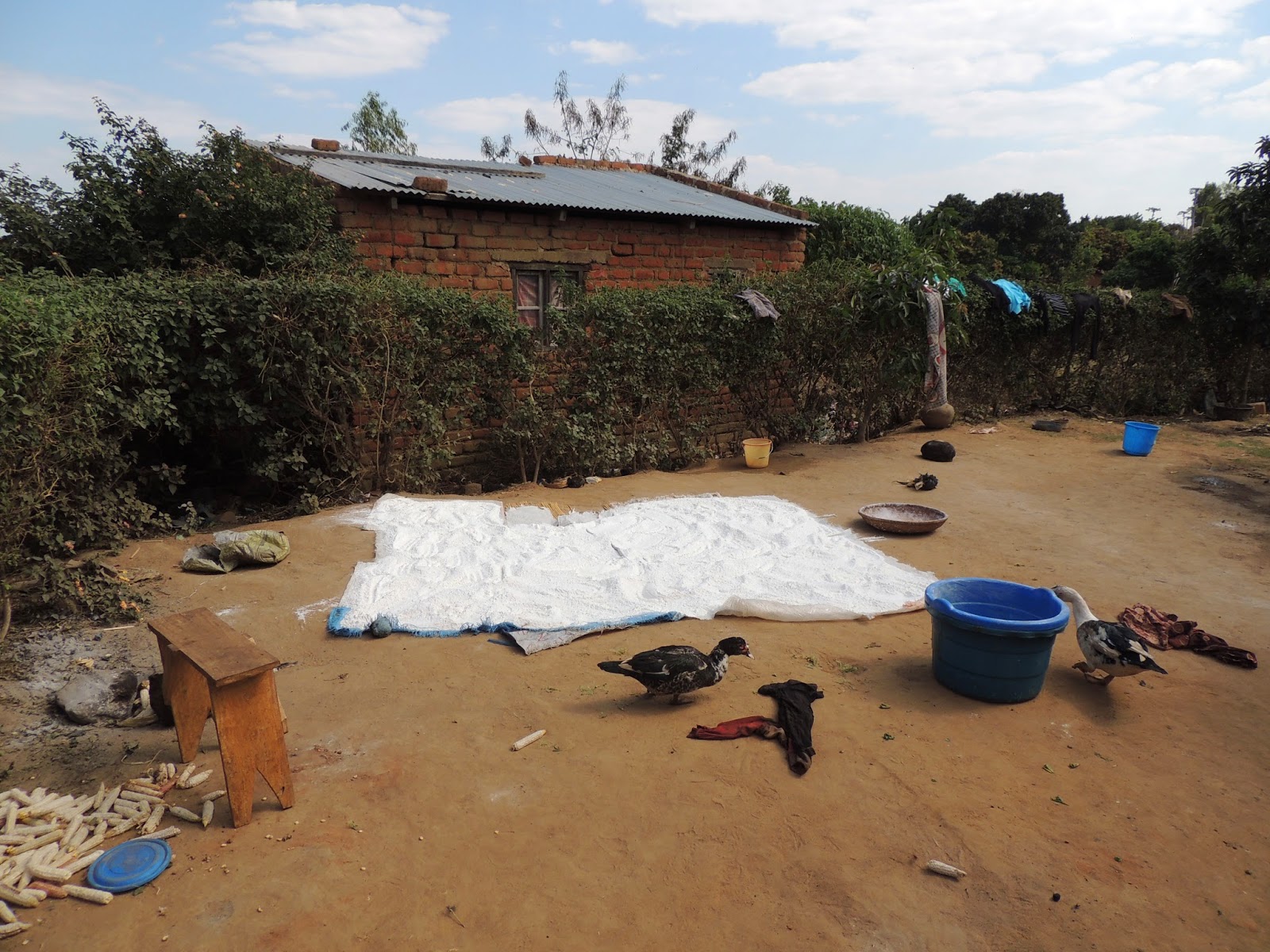
In April, the harvest began and suddenly the fields were clear again.  Piles of corn appeared in people's yards for drying.  After harvest, the next step is to remove all the corn kernels from the cobs and store them in bags.  Once this is done, a family will take a bucket of corn to the mill to grind into corn flour as needed throughout the year.  For many people in Zobue, xima, a kind of corn flour gruel is a daily staple.  If the harvest is good enough, the corn reserves will last until the harvest next year.  If not, there may be a time of hunger before the next corn can be harvested.  Luckily, Zobue is a productive area with good soil and adequate rainfall so most people here have enough to eat year-round.  Unfortunately, this is not true of many parts of Mozambique where sandy soil and a long dry season prevent good corn yields.  In drier areas, millet is also grown as it requires less water than corn.

Besides an important source of food, the corn grown in Zobue also provides the villagers with a local source of alcohol.  Bombe is a popular drink in Zobue and is made from fermented corn mash.  To make bombe you simply coarsely grind the corn, boil it in water for a few hours, then wait 3-4 days for the concoction to ferment.  Then you rent speakers and play loud music to tell everyone in town you are selling bombe and there is a big party at your house!  I've tried it--not my favorite.  It is thick and chunky and tastes like sour corn.  I definitely couldn't drink a whole cup of it without feeling nauseous.  But, I supposed it is an acquired taste.

A corn field after the harvest
Corncobs
The corn kernels waiting to be ground into flour.

Washing corn kernels
Grinding corn into corn flour at the mill
Two women leaving the mill with their baskets of corn flour
After going to the mill, the corn flour dries in the sun.
Before using the corn flour, it is sifted using the flat baskets shown in this photo.
Bombe, the corn beer, being boiled over an open fire.
Two women waiting for their bombe to finish boiling.


Monday, June 30, 2014

Time

In the United States daily schedules revolve around the hours in the day, regardless of the time of year. In the winter when the days are shorter, people simply go about life in the dark.  Even though the human body just wants to curl up in a cozy bed and hibernate, the iron schedule does not yield to the changes of the seasons.  Even when it gets dark at 4 pm, there are still errands to run, meetings to go to, events to attend, and work to do.  This schedule is completely contrary to our biological clocks.  Before electricity was common, people would simply stay up later during the summer when the days were longer and sleep more in the winter when the days were shorter.  Last winter I remember talking to a friend about this phenomenon and wishing we could still live that way. Because let’s face it: nothing is harder than getting out of bed at 6 am in the winter when it is still dark and freezing outside.

In Zobue, the daily schedule adjusts to the length of the day.  The market opens at daylight no matter if that time is 5 am or 6 am.  The kids on our porch stay until dark regardless of what time it is.  In December, they stay until 7:30.  Now, they are gone by 5:30 and I stand in my house wondering how it feels so late when it isn’t yet 6pm.  The longer winter evenings mean more time to rest and prepare for the next day.  Granted, since we are closer to the equator here the days don’t fluctuate as much as they do in northern latitudes, but it’s nice for these two years to live more closely with nature’s rhythm than by the unyielding schedule of the clock. 


There are disadvantages to living this way as well.  Lately, one of my classes has been missing out on instructional time because even though the class is supposed to go until 5:35, by 5:15 the sun is setting and all the students are restless to leave.  Usually I try to keep them in class anyway, but when I can’t even read the numbers on the chalkboard I concede defeat and let them go home.

Saturday, June 28, 2014

June 25: Mozambican Independence Day

Mozambique actually celebrates two independence days.  September 25 commemorates the day in 1964 that Eduardo Mondlane proclaimed the beginning of the armed struggle for independence from Portugal.  June 25 commemorates the day in 1975 when Mozambique was finally declared an independent nation.  

This past Wednesday we celebrated the latter.  For many people in Zobue the day is simply an excuse to drink all day, but the day was also full other activities.  Classes were canceled and everyone gathered in the town square for cultural dances and presentations.  Groups from the primary and secondary schools performed, but to me the most interesting was the dance of the Nyau.

The Nyau (sorry I have no idea how to spell that) are a part of the Chewa culture, a cultural group that exists in Northern Tete province and most of Malawi.  My impression is that it is like a secret society of men from the community who meet in secret to perform certain ceremonies.  They dress up in different costumes and come out during funerals to chase people in the town.  Everyone in the town has to run and hide from them as a form of respect. I’ve been told that the Nyau will beat people who don’t run from them.  And I believe it—they carry machetes, whips, and tree branches.  For those of you at home who are terrified for me, I’ve also been told that they won’t beat me up because I’m not part of the Chewa culture.  I believe them, but when everyone else around me is running, I run too.  Better safe than sorry.

One afternoon there was a funeral near my classroom and there were many Nyau roaming the street.  I was giving a test that day and it kept getting interrupted by people running into my classroom to hide from the Nyau.  Another time I was walking with Seni and Romao and we saw a large Nyau yelling and brandishing his machete on the road ahead of us.  We had to hide behind someone’s house and cut through a few random yards to avoid facing the Nyau.

Every time I’ve seen the Nyau around town I’ve been too scared to take a picture.  I haven’t known if it is allowed and am afraid I will break some cultural taboo.  On Wednesday, they came to do a dance presentation during the Independence Day festivities and luckily we were told photos were allowed.  I got some great video of them dancing as well, but unfortunately can’t upload it until I get some better internet. 


To a lot of people, the Nyau sound very scary.  When I first heard about them I thought, wow, I hope I don’t get placed in a region of Mozambique where they are.  But here I am in Zobue where the Nyau are fairly common.  When we first came to Zobue, I was afraid of them because I didn’t understand them and wasn’t familiar with them.  Now, I am more used to them and see them more as an interesting part of the local culture than as something scary.  


Thursday, June 26, 2014

Cape Maclear

While we were in Malawi we also visited Cape Maclear, a beach area on the shores of Lake Malawi.  It was a bit of a challenge to get to, but definitely worth it.  We stayed at a lovely lodge right on the beach and sunbathed, kayaked, and watch the World Cup.  What a great vacation spot.


A local Malawian woman washing dishes on the beach.  
A woman selling catfish on the beach.

Liwonde National Park Take 2

While Terra and Gabe were visiting we spent a weekend in Malawi.  We went to Liwonde National Park, the same park I went to with my dad when he was here in April.  I was able to get some better pictures of the elephants and hippos this time.  Another notable event about our trip was that we ate hippo! It was on the menu at the restaurant so we ordered it.  Apparently sometimes the rangers at the park have to kill a hippo for population control and afterwards the meat is available to buy in the market.  I thought the hippo curry I ordered was pretty good--kind of like really chewy beef.  During Terra and Gabe's visit I also ate pigeon, which was surprisingly good.  Not much meat, but way more flavorful than chicken.  People here in Zobue raise them in little houses in their yards and either sell them or eat them themselves.


I don't have a photo of the hippo meat, but here is the pigeon...like a tiny, tiny chicken.


Visitors!

The past three weeks I was lucky enough to have another set of visitors from home.  My sister Terra and her boyfriend Gabriel arrived May 30 and left this past Monday.  While they were here we spent a lot of time in Zobue and did some travelling to Malawi and other volunteer's sites as well.  Terra and Gabe really settled in well to life in Zobue.  Through a mixture of Spanish, Portuguese, and Nyungue they were able to communicate pretty well.  They made friends at the market and knew their way around the town very well.  I didn't want them to leave!

Here are some photos of their time in Zobue.
Terra with some of the neighbor kids
Hiking around Zobue
Dinner with friends!
Terra and Gabe with Marnela
Suneila was really interested in Gabe's Indiana Jones hat.

Sisters!
Terra wanted to learn how to carry a baby with a capulana so she practiced with a bunch of grapefruits.
Then Gabe wanted to practice carrying Terra...
...but he couldn't tie it so she's a crying baby.
Terra succeeded in the tying the capulana so Alinafe is safe and secure

Gabe bought a slingshot and had a lot of fun with the neighbors having shooting competitions.
Seni was a pro at the slingshot.
Quinta Monte was also a big part of the visit.  We went there for chicken and fries about 6 times.  Here, Terra and Gabe are sad because it is their last time at Quinta Monte.