Wednesday, November 5, 2014

Livro Aberto

In the past few weeks I've been working on developing the program for the Zobue Community Library, also known as Livro Aberto Zobue.  Livro Aberto means Open Book in Portuguese.  Since the beginning of October we've been able to do community library programming where the children actually get to choose books to read and read them independently.  It is very exciting for these students because many of them have probably never touched a book before, let alone new books with lots of colorful pictures.  Right now we are holding the community library program from 10-12 on Tuesday mornings.  We've settled on a schedule that has worked well for the past few weeks.

First, we start with a Bom Dia (good morning) song.  This activity helps settle the kids and introduce them by name.  Second we go over the alphabet.  Our goal is for all the students to know the names of the letters.  

After practicing the alphabet a few times we transition to our letter of the day.  We learn about the sounds of the letter, how to write the letter, and we draw a few things that start with that letter.  
This week our letter of the day was the letter F.  In this photo I am asking the students who has seen a formiga (ant) in their house lately.  It is ant season here so almost everyone should be raising their hands.

Next, I ask for volunteers to name other words that start with F.  This week we came up with words like faca, final, Francisco, and falta.


After going over the letter on the board, the students write down the words in the notebooks.
In this photo I am helping a students write the letter F.

Children working on writing their letter Fs.
After the writing and drawing activity, we do a little song and dance to get the kids moving a bit.  They love this song because they get to jump around and be silly.
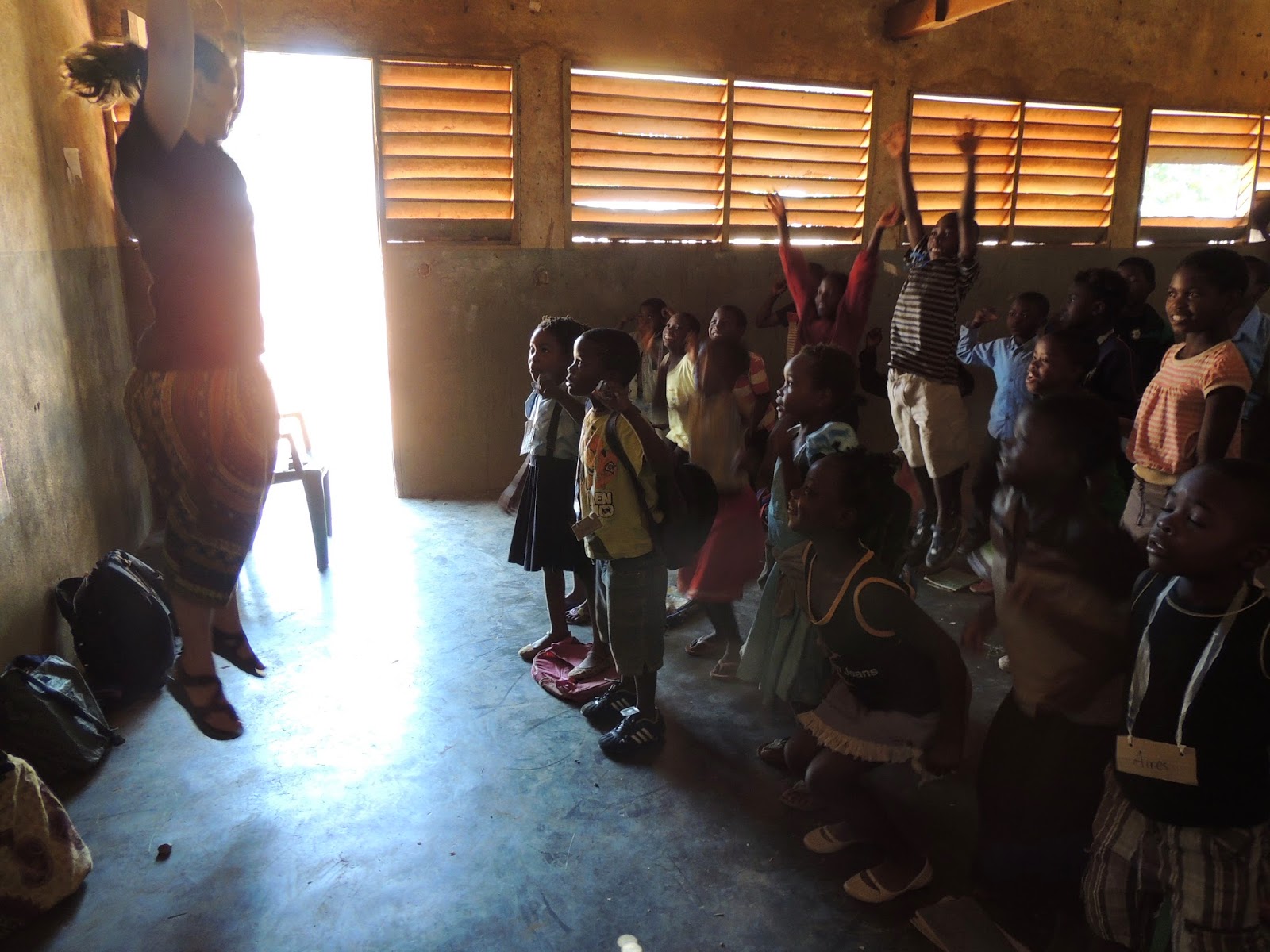
After a quick break it is time for read aloud.  
Here I am reading the book David Vai a Escola
 Finally, the last activity of the day is independent reading.  Since we have students from 5th grade and students from 2nd and 3rd grades, I have each 5th grader find one or two younger students to read with.  After washing hands (very important before touching books) the children can choose books to read.
Reading time!


A 5th grade student helps a younger student read a book about colors.


The Nao David books are a big hit.


So far the reading program has been going really well.  It will be challenging keeping it going during the holidays, but I hope to start up again when school starts again next year.  My goals for next year are to train community members or other teachers to help run the program and perhaps expand the program to more days. I am so thankful for the opportunity to develop this program in Zobue.  Photo credits to Kevin Nguyen.

Thursday, October 16, 2014

Mountain Cooking

Over the past few months I've continued to take some kids from Zobue hiking in the mountains on Saturday afternoons.  Most of the time it's just a quick walk and then we get cookies afterwards, but last week the kids asked if we could bring rice and cook on the mountain.  "You want to cook food on the mountain?" I asked.  "YES!" they said.  Ok, why not? I thought.  So that is how I last Saturday I found myself on the rocks behind my house, helping ten-year old girls cook rice and macaroni while the boys ran around collecting firewood.


We built the fires using three rocks to rest the pot on and poking sticks through the gaps between the rocks.  Everything is extremely dry this time of year and it was windy up there so the fires burned well.  In no time we were boiling water and cooking away!


As we waited for the food to cook, the kids had a great time jumping, dancing, and doing acrobatics for the camera. 


Finally, it was time to eat.  The kids crowded around the food with plastic bags and pot lids (we didn't bring any plates or silverware) and the oldest girl portioned out the food using a small tupperware container.  In true Mozambican fashion there was a lot of yelling and arguing over who got what, but eventually everyone seemed to be happy.  Also true to Mozambican culture, the boys went off to eat in a separate area while the girls grouped around the pots and scooped out food with their hands.  Coming from a culture where eating meals together very important, this separation of gender is still strange to me.  In Mozambique families rarely eat together, most often members of the family will eat at very different times throughout the day.   Conversation at mealtimes is also rare.  I miss a culture that values family meal time and conversation.


Here, the girls are guarding the rest of their food from the boys who want to take more.


The boys eating in their area.
 After eating, the kids quickly found some pieces of plastic and scraps of cardboard to use as sleds to slide down the rocks.  Someone had even built a landing pit made of dry leaves so the kids could do flips and trick landings at the end of the slide.


This Saturday cooking time with the kids was fun, but it also made the gender roles in Mozambique extremely clear to me.  The girls did all the cooking and cleaning up while the boys played around until the food was done and then made a fuss when the food wasn't perfect.  These kids don't know any different and are probably fine with their situations, but it makes me feel lucky that I am from a culture with gender roles that aren't so rigid.    


Saturday, October 4, 2014

National Science Fair

Two weeks after the Provincial Science Fair in Tete I travelled to the National Science Fair in Maputo.  Students from each province competed in the fair, including the two students who won the Tete Provincial Fair.  Overall, the National Fair was an impressive event.  It was two full days in length and included presentations by the students, demonstrations by professors, cultural dance performances, and theater performances. Here are some photos of the event.

Tarcisio, one of the students from Tete, and another competitor waiting for the event to start.

This student built a water distillation apparatus.

This student built a security system that would tell a guard which door or window the intruder entered in the case of a robbery.

This student built a scale for weighing vegetables or grains.
This student built an air-conditioner.


One of the dance groups

One of the winners receiving her trophy.

 
The winners received laptops and medals.
My two students from Tete and me.

Wednesday, September 10, 2014

Provincial Science Fair

It's been a while since my last post--since then I've spent a week in Nampula at a community library training conference, four days in Pemba visiting my friends Rayna and Kristina, a few days teaching in Zobue, and two weekends planning and realizing the Tete Province Science Fair in Tete City.

As provincial coordinator for science fair in Tete, I was responsible for making the Provincial Science Fair happen.  I worked with a few people from the Ministry of Science and Technology in order to make T-shirts, order food, reserve the space, and make sure the students from the outlying districts knew about the fair.  My counterparts were a huge help--I couldn't have done it without them.  Regardless, there was certain amount of stress in anticipation of my first provincial science fair.  Would we have enough food? Would the T-shirts be ready in time? Would I have enough money to reimburse people for travel to the fair? Would I get all the required forms filled out? Would the HIV testing organization show up?

I am happy to say that the fair went as well as I could have hoped for.  It was a Mozambican event so it started 2 hours late, but we had enough food and T-shirts for everyone and most importantly, enough certificates for all the participants.  Eighteen students from four districts participated in the fair by presenting their science projects to a panel of judges.  More students from other districts would have shown up, but many teachers are already busy helping campaign for the October election and thus unable to accompany their students to the fair.

It was fun to see the different projects each student presented.  Some of the projects included an electric kettle made from an old water jug, a solar oven, and a model of a city water system.  The students each presented their project for ten minutes, then received feedback from the panel of judges and the audience.

The most frustrating part of the fair was hearing the judges and teachers give such negative feedback to the students.  Mozambique doesn't seem to have a culture of positive reinforcement and constructive criticism.  Feedback is extremely harsh and negative.  As an American who has been raised to always mix positive feedback with areas for improvement, it is hard for me to listen to teachers and other adults harshly criticize and insult students for their less-than-perfect projects.

For example, one student made an amazing plane out of wire, paper, and other recycled items.  He had even wired a battery into the plane so that it would move along the floor.  Instead of complimenting the student on his creative project, the judges and other teachers told him that the plane should be flying instead of moving on the floor.  They said he shouldn't have even presented the project since the plane didn't fly.  The student looked completely dejected and probably won't want to participate next year.

Next year, if I help to coordinate the fair I want to focus of fostering a culture of positive reinforcement in order to encourage students instead of only criticizing them.

This girl one first place in the 8-10th grade division by extracting DNA from a banana.

This boy won first place in the 11-12th grade division by making a gel out of soap, wax, and oil that heals wounds and prevents HIV transmission.

The two winners of the fair get to compete in the National Science Fair in Maputo.  I will travel there with the two students on September 17th.  It is an amazing opportunity for these students who have probably never left the province.  I'm happy to be a part of this program and look forward to seeing the projects of the students from other provinces at the national fair.

Setting up for the fair

Opening remarks

There were about 60 people present at the fair

Solar oven