Saturday, October 4, 2014

National Science Fair

Two weeks after the Provincial Science Fair in Tete I travelled to the National Science Fair in Maputo.  Students from each province competed in the fair, including the two students who won the Tete Provincial Fair.  Overall, the National Fair was an impressive event.  It was two full days in length and included presentations by the students, demonstrations by professors, cultural dance performances, and theater performances. Here are some photos of the event.

Tarcisio, one of the students from Tete, and another competitor waiting for the event to start.

This student built a water distillation apparatus.

This student built a security system that would tell a guard which door or window the intruder entered in the case of a robbery.

This student built a scale for weighing vegetables or grains.
This student built an air-conditioner.


One of the dance groups

One of the winners receiving her trophy.

 
The winners received laptops and medals.
My two students from Tete and me.

Wednesday, September 10, 2014

Provincial Science Fair

It's been a while since my last post--since then I've spent a week in Nampula at a community library training conference, four days in Pemba visiting my friends Rayna and Kristina, a few days teaching in Zobue, and two weekends planning and realizing the Tete Province Science Fair in Tete City.

As provincial coordinator for science fair in Tete, I was responsible for making the Provincial Science Fair happen.  I worked with a few people from the Ministry of Science and Technology in order to make T-shirts, order food, reserve the space, and make sure the students from the outlying districts knew about the fair.  My counterparts were a huge help--I couldn't have done it without them.  Regardless, there was certain amount of stress in anticipation of my first provincial science fair.  Would we have enough food? Would the T-shirts be ready in time? Would I have enough money to reimburse people for travel to the fair? Would I get all the required forms filled out? Would the HIV testing organization show up?

I am happy to say that the fair went as well as I could have hoped for.  It was a Mozambican event so it started 2 hours late, but we had enough food and T-shirts for everyone and most importantly, enough certificates for all the participants.  Eighteen students from four districts participated in the fair by presenting their science projects to a panel of judges.  More students from other districts would have shown up, but many teachers are already busy helping campaign for the October election and thus unable to accompany their students to the fair.

It was fun to see the different projects each student presented.  Some of the projects included an electric kettle made from an old water jug, a solar oven, and a model of a city water system.  The students each presented their project for ten minutes, then received feedback from the panel of judges and the audience.

The most frustrating part of the fair was hearing the judges and teachers give such negative feedback to the students.  Mozambique doesn't seem to have a culture of positive reinforcement and constructive criticism.  Feedback is extremely harsh and negative.  As an American who has been raised to always mix positive feedback with areas for improvement, it is hard for me to listen to teachers and other adults harshly criticize and insult students for their less-than-perfect projects.

For example, one student made an amazing plane out of wire, paper, and other recycled items.  He had even wired a battery into the plane so that it would move along the floor.  Instead of complimenting the student on his creative project, the judges and other teachers told him that the plane should be flying instead of moving on the floor.  They said he shouldn't have even presented the project since the plane didn't fly.  The student looked completely dejected and probably won't want to participate next year.

Next year, if I help to coordinate the fair I want to focus of fostering a culture of positive reinforcement in order to encourage students instead of only criticizing them.

This girl one first place in the 8-10th grade division by extracting DNA from a banana.

This boy won first place in the 11-12th grade division by making a gel out of soap, wax, and oil that heals wounds and prevents HIV transmission.

The two winners of the fair get to compete in the National Science Fair in Maputo.  I will travel there with the two students on September 17th.  It is an amazing opportunity for these students who have probably never left the province.  I'm happy to be a part of this program and look forward to seeing the projects of the students from other provinces at the national fair.

Setting up for the fair

Opening remarks

There were about 60 people present at the fair

Solar oven

Friday, August 15, 2014

Mulanje Massif

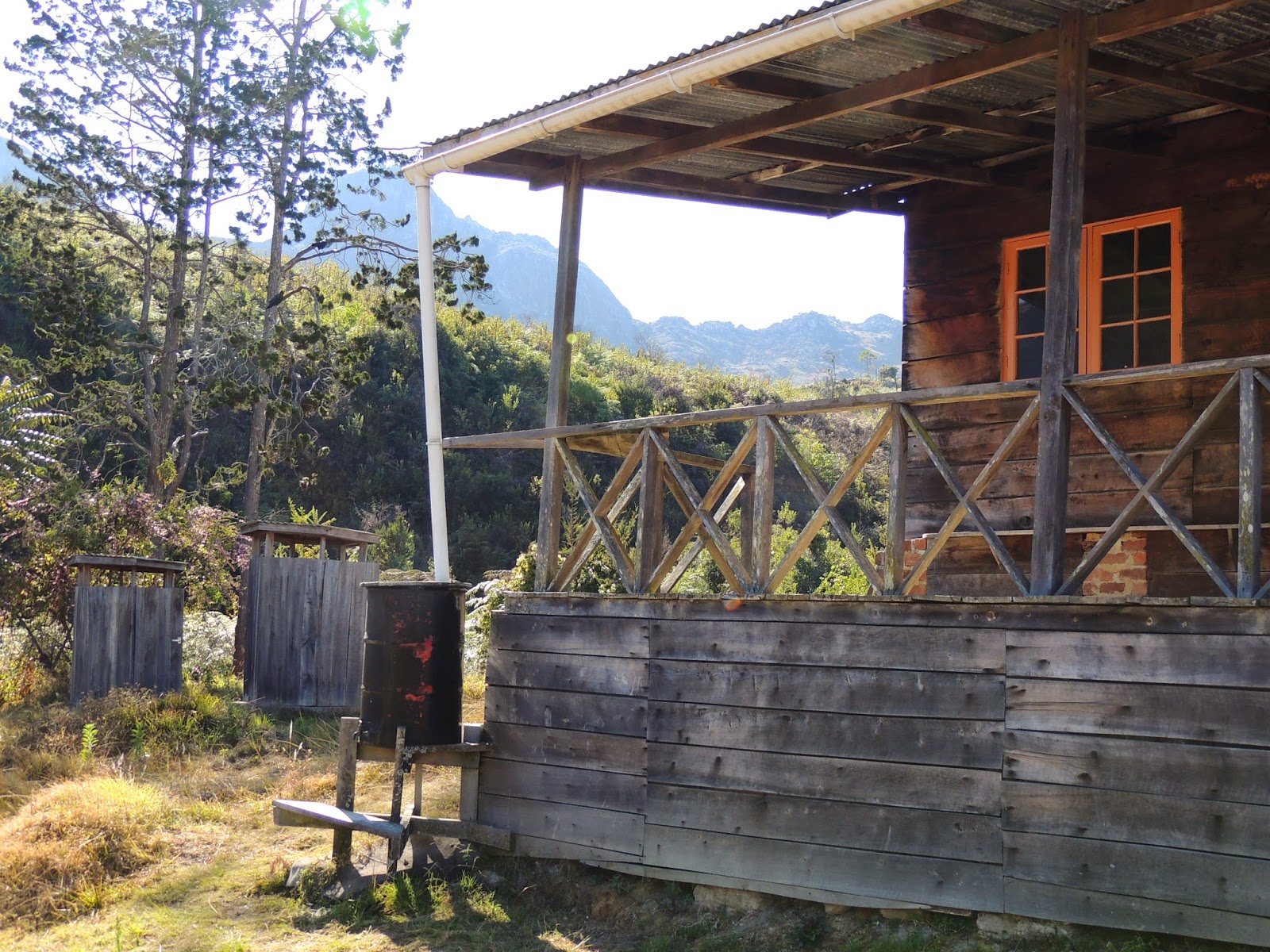
Last week I spent 5 days hiking on the Mulanje Massif, a huge group of mountains in southern Malawi.  These mountains are made mostly of granite, a rock that is very resistant to erosion.  Over thousands of years, the softer rocks around the granite have eroded, leaving the granite rising up dramatically from the plain.  The massif has been called an island in the sky--and that's exactly what it's like.  The forest service has built huts in various places on the mountain.  Their fireplaces are a source of welcome warmth once the sun goes down at 6 pm.  Even in Malawi, it gets very cold at 9,000 feet of elevation! 

This is the view of the massif from the town of Likubula, where we started our hike.  Elevation: 200 m

My hiking companions, Laura and James.  They are super excited to get started!

The first day was the hardest--we gained 6,000 feet of elevation in 5 hours.  The views, however, were gorgeous.


Our guide Robert and me on the Chambe Plateau.
Approaching our first hut, Chambe Hut.

The hut had a great view of Chambe Peak, the hardest peak to ascend in the whole massif.

The huts were complete with bath houses...

...with lovely views!


On the third day we summitted the highest peak, Sapitwa.  At 10,000 ft of elevation it was not easy, but the trail was well marked with many red arrows.  In ChiChewa, Sapitwa means "don't go there." 

Very exciting: ice in Malawi!

I hadn't seen ice on the ground for over a year...very exciting!

We made it to the summit!


Wednesday, August 6, 2014

Life in Zobue: Carvao (Charcoal)

Most people in Zobue cook every day using a charcoal stove.  Even people with electricity in their homes prefer to use charcoal over an electric stove.  I haven't quite been able to figure out why, except that charcoal is more reliable--it doesn't stop working when the electricity goes out.  People are also probably more used to cooking on a charcoal stove because that is how they grew up.  When Silvia and Albertina have been over to cook with us, they seem scared to use our electric stove because it is unfamiliar.  For me, charcoal is a pain to cook on because it takes a long time to light, but for most people here it is easier than an electric stove.  


Most people cook on small charcoal stoves like this one.

The charcoal is sold in large bags like this for about 100 mets (3 dollars). A family cooking on charcoal would probably use 4-5 large bags per month.

Here are more large charcoal bags for sale.

Charcoal is also sold in smaller bags like this for 25 mets (about 1 dollar)

This small store is selling a few small bags of charcoal

Celena waits for the water to heat up on her charcoal stove so she can take a bath


Servina cooks xima on her charcoal stove


Here are some small charcoal stoves for sale at the market.
Mozambique uses a lot of trees every year to produce charcoal, make bricks, and build houses and I'm afraid of what is going to happen when there are no more trees.  Currently the rate of tree use is much greater than the number of new trees being planted.  How will people cook? Build houses? Stay cool during the hot season when there are no shady trees to sit under?  It is hard for people who are barely making a living to care about their environmental impact, but it is something Mozambique is definitely going to have to deal with in the near future.  The population is growing and Mozambique is in need of more sustainable practices to support the growth.

Thursday, July 24, 2014

Rata de Mato

So far in Mozambique I've tried a lot of new foods: hippo, goat, and corn beer to name a few. One thing I haven't been able to try yet is the rata de mato, the bush rat. People sell these little rats at a good price on the side of the road or at any market.  They are roasted--skin, hair, bones, and all--and sold for about 50 cents per half dozen.  At first I thought people just ate them like that, as a kind of street snack, but I haven't actually ever seen anyone eating them.  The other day I was on a chapa and the people on either side of me bought multiple sets of rats so I was able to get some photos and ask questions.  Apparently they don't eat them straight off the stick, but usually cook them in a stew with tomato and onion.  It seems really gross to me, but these rats are a good source of protein in a place where many people are severely protein deficient. So I won't judge people here for thinking they are delicious.  I just probably won't be trying them any time soon. 


Thursday, July 17, 2014

Brick making part II

After the last post about brick making in Zobue a friend of mine asked if I had a picture of the mold used to make the bricks.  At the time I didn't have a photo, but have been on the search ever since. A few days ago I asked a young man I had seen making bricks if he had the mold and he said he had borrowed the mold from someone else and had already returned it.  Yesterday, I was running along the road and saw a man carrying a brick mold, but I didn't have my camera. This morning I went for a walk around Zobue with my camera and had the good fortune of walking by a man making bricks with his very own brick mold.  So, here are some photos of the brick mold plus some more photos of the brick making process.

These men are piling up the dried bricks, leaving room at the bottom to build fires underneath and bake the bricks.

I asked this man if I could take a picture of him and he struck this pose.  The mold is supporting his right hand.

Here is the brick mold.  You can make two bricks at a time.  Simply pack in the mud, carry the mold to where you want your bricks, and flip over the mold, letting the new bricks fall out onto the ground to dry.


In the previous post I showed a picture of a house being built.  Here is it a few days later.  They are making progress!


I thought it was interesting what they use to make sure the walls are square.  Just some string and a stick.  Seems to work pretty well.


Tuesday, July 15, 2014

Life in Zobue: Water

Continuing my Life in Zobue series, here I'm going to talk about water.  Most homes here in Zobue do not have running water so every day women and girls carry water from the nearest pump back to their homes for bathing, cooking, washing dishes, drinking, and cleaning.  To carry this water, they balance the full jugs on their heads.  Emma and I employ a local woman named Rute and her mother Fatima to bring us water every other day.  The jugs are quite heavy and our nearest pump is pretty far away so these women are very strong.  One day I carried the smallest of our jugs home from the pump on my head and it was hard! I made it home, but barely, and I spilled about a quarter of it on myself on the way.  


Here is our water storage area.  Rute even carries the big blue one in the middle/back on her head.  It holds about 50 liters...which weighs over 100 pounds.


Doing dishes with baby Wilder.


But where does the water come from? Is it clean? Safe to drink?

In Zobue, some people have hand-dug wells in their yards that provide them with water.  They have a bucket on a string that they lower down, fill with water, and bring back up again.  This source of water is convenient, but since the top is open it can easily get contaminated.

Other people in Zobue (including me) pay 20 meticais (about 60 cents) per month to use one of various closed water pumps to get their water.  Since the top is closed there is no way for trash and debris to get in and contaminate the water, so it is very clean.  I still filter and bleach my water before drinking it though, just to be safe.


This is an example of one of the closed water pumps that exist around town.


This girl is stabilizing the water jug with her hands, but most women are able to balance these heavy jugs on their heads without requiring stabilization. They sometimes even carry two more smaller jugs of water in each hand while still having the big one on the head.  Amazing.


Some people get their water from the small streams that run through town.  This water is not very clean, but serves well for clothes washing and bathing.  Many women carry their laundry down to the stream and wash it there to save the trouble of carting lots of water just for washing clothes.  They then bring the clothes home and hang them up to dry in their yards.

This is Silvia carrying her laundry to the stream to wash.


So far we haven't had any water shortages, but I haven't yet been here in the height of the dry season so I don't really know how scarce the water gets.  I've heard that in the dry season some of the hand-dug wells go dry so there is more demand for the closed pumps since they are deeper.  This means that the lines for water start getting long and people have to line up at 4 am to get a good spot in the line.  Hopefully this year the ground will have enough water to last through the dry season and there won't be any problems, but you never know.